Is my pool leaking or is it evaporation?
Evaporation takes water from your pool and from a bucket of pool water at the same rate, so the bucket test is the fair way to tell the two apart. If the pool drops noticeably more than the bucket over the same days, the extra loss is a leak, not the Las Vegas, NV heat.
Three things push the answer toward a leak before you even fill the bucket:
- The pool keeps losing more than a bucket of its own water beside it.
- The ground near the equipment pad, or along the run between the pool and the pad, stays wet or soft when nobody has watered.
- The level falls, then stops at the same height every time you let it go.
That last one is easy to miss, and it often points straight at a fitting.
- 1Skimmer, set at the water line and piped to the equipment.
- 2Return fitting, where filtered water comes back into the pool.
- 3Light niche, the recess in the wall that holds the pool light.
- 4Main drain at the deepest point of the floor.
- 5Equipment pad: pump, filter and the ends of the underground lines.
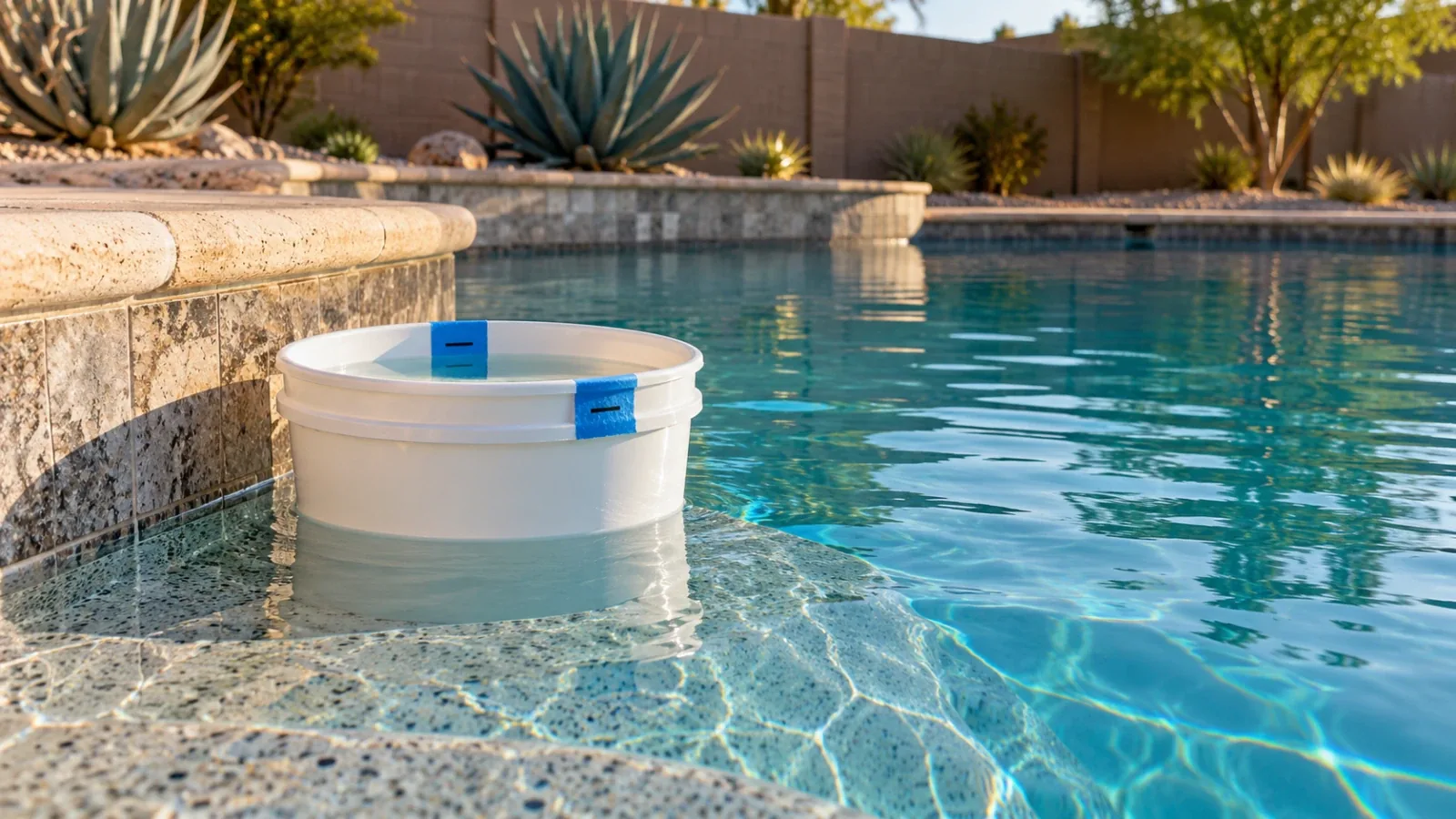
- 6Bucket test: a bucket on a pool step, rim a few inches above the water line, left undisturbed for several hot days. If the water in the bucket ends up noticeably higher than the pool's, the pool may be losing water to a leak.
Why Las Vegas, NV pools lose so much water to evaporation
Heat, strong sun, dry air and wind all pull water off an open surface, and the Mojave Desert climate around the valley supplies plenty of each through the summer. The Southern Nevada Water Authority puts a number on it: SNWA says the average in-ground pool loses 48.6 gallons per square foot of surface each year to evaporation, and that a typical Southern Nevada residential pool of around 470 square feet can lose as much as 22,842 gallons a year.
Those are annual totals. SNWA does not publish a daily or summer-only figure, so be wary of any single "normal inches per day" rule you read online. Sources quote different numbers, and your yard's sun, shade and wind exposure change the result anyway. That is the case for the bucket: it measures your pool, in your yard, in this week's weather.
Evaporation slows in the cooler months. That makes fall and winter the easier seasons to prove a leak, because a loss that held steady from July into November is much harder to blame on the sun.
How to run the bucket test
SNWA describes the bucket test as a few hot days with a bucket on a pool step, then a comparison of the two levels. Here is the version we suggest, with a second pass added:
- Fill a clean bucket with pool water to an inch or so below the rim. SNWA asks for the rim to sit at least a few inches above the pool's water line.
- Set the bucket on the first or second step so it stays at pool temperature.
- Mark the water level inside the bucket with tape or a marker, and mark the pool level on the tile or skimmer face outside it.
- Turn off the auto-fill. Skip swimming and backwashing until the test ends.
- Let the pump run on its normal schedule.
- After 24 hours, and again after a few days, measure how far each level has dropped from its mark.
- Reset the marks and repeat with the pump off for the same length of time.
Why run it twice? Because pool plumbing has two sides. While the pump runs, the return lines and the fittings at the equipment pad are pushed under pressure. With the pump off, those lines relax, and only the shell and the suction side are left holding water. A leak usually shows itself on one side more than the other.
Reading your bucket test results
| Result | What it likely means | Next step |
|---|---|---|
| Pool and bucket drop about the same | Evaporation | No visit needed. Re-test if the loss changes. |
| Pool drops more than the bucket, pump on | Pressure-side leak: return lines or equipment pad fittings | Look for damp soil at the pad, then book a check |
| Pool drops more than the bucket, pump off | Suction side or the shell | Book a check; note where the level settles |
| Level stops at the same height each time | Leak at or near that height: skimmer, light niche, tile line | Note the height before anyone visits |
If the pool and the bucket drop by the same amount, it is evaporation and nobody needs to come out. If the pool is losing more than the bucket, talk to a leak detection specialist before anyone drains it.
The "stops at a fixed height" result deserves a sentence of its own. Water cannot leak out through an opening that sits above the water line. So a pool that keeps falling and then holds steady often stops at the bottom of the skimmer mouth or just below a light niche, and that height points the search at those fittings first.
What throws the bucket test off
A bad reading usually comes from something that added or removed water during the test, not from a faulty bucket.
- Monsoon rain. NWS Las Vegas notes that monsoon season in southern Nevada typically begins around early July. A single storm can drop water into both the pool and the bucket in uneven amounts, so stop and restart after it passes.
- The auto-fill left on. It quietly replaces whatever the pool loses and hides the answer.
- Heavy swim days. Kids, dogs and cannonballs carry water out on every exit.
- Backwashing. A filter backwash during the test sends pool water down the drain line.
- Spa spillover. With an attached spa, water moving between the two bodies can skew a short test.
- One very windy afternoon, which can splash water out over the coping.
Signs that point to a leak, not the weather
Some signs show up without any test at all. Wet or soft ground near the equipment pad, or between the pool and the pad, is the common one. Others include cracks or loose tiles along the waterline, air bubbles in the pump basket, an auto-fill that seems to run all the time, and a water bill that climbs while the weather stays the same.
Leaks in a pool tend to sit at fittings: skimmers, lights, returns and the main drain, plus the buried lines that connect them. Each pool is different, and our page on pool leak detection for Summerlin homes walks through where those checks usually start.
The auto-fill and your water meter
An auto-fill valve tops up the pool without anyone noticing, which is exactly why it can mask a leak for months. With a leak present, it may run almost nonstop. On an LVVWD account that pattern looks like continuous flow at the meter, which LVVWD's advanced metering flags. The district gets in touch once that nonstop flow has lasted three days or more. Some pool owners learn about a leak from that notice rather than from the tile line.
Henderson, NV pools are on City of Henderson Utility Services, not LVVWD, so the LVVWD notice does not apply to those accounts. Owners there can still read their own meter, and our Henderson pool visits start from the same check.
The meter also answers a different question: is the water going to the pool at all? Shut off the auto-fill, turn off every tap, sprinkler and appliance inside and outside, then check the little leak-indicator triangle on the meter face. LVVWD's guidance is that a triangle still turning with everything off may mean a leak. If the pool's auto-fill is off and the triangle still moves, the leak may be in the house or yard plumbing rather than the pool, and that changes who should look first.
Because Leak Detection Las Vegas covers the house and the pool, both sides can be checked in one visit if the bucket and the meter disagree.
What happens after a failed bucket test
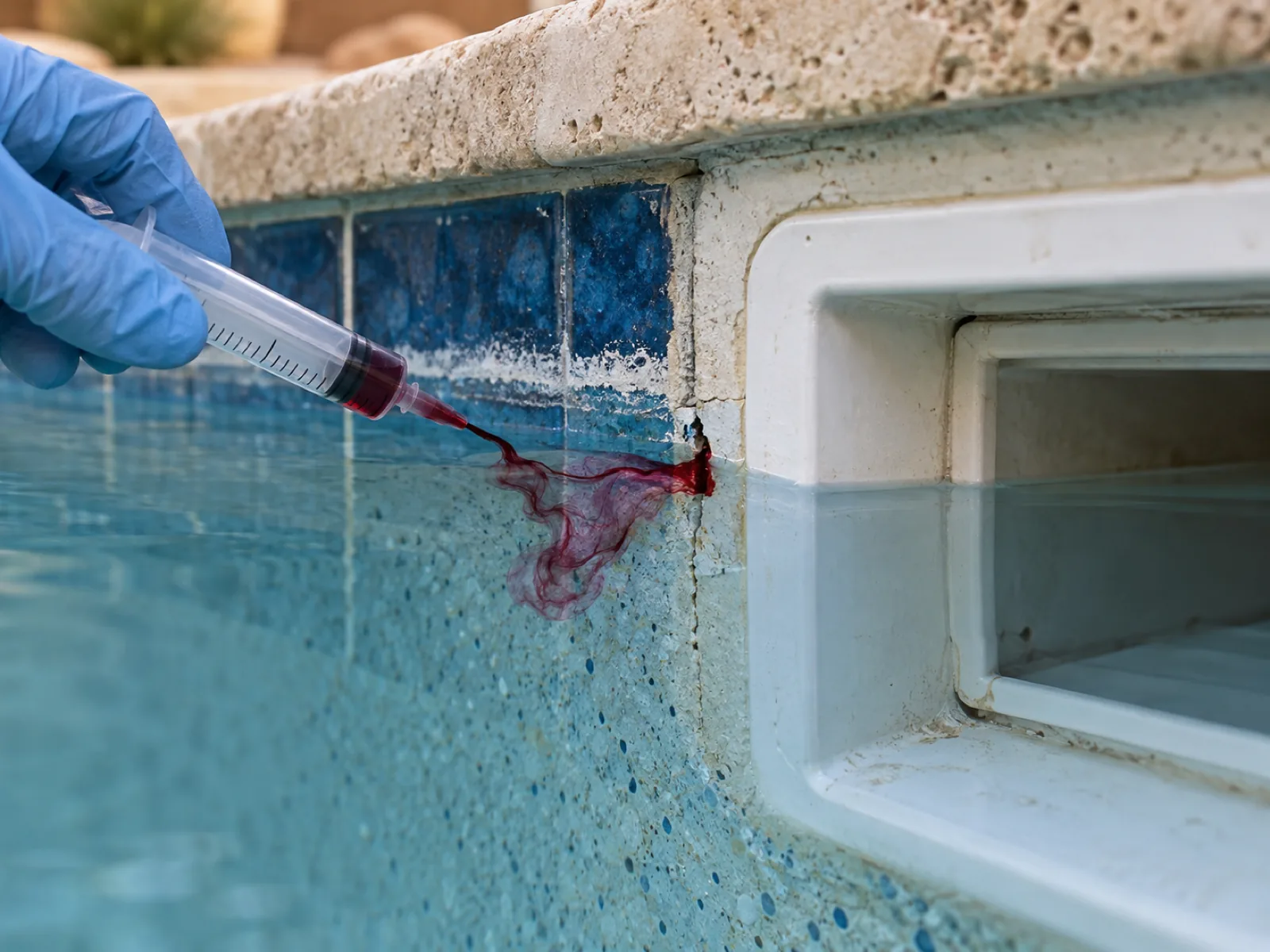
A failed test does not mean the pool gets drained. Pool leaks are usually located with the water in. A technician can pressure test the individual return and suction lines to find which one loses pressure, then drop dye near fittings, lights and skimmers to watch where the water pulls it. Listening on buried lines can narrow a leak along the run between the pool and the pad.
All of that happens before any decking is cut or any surface is opened. Our guide to how leak detection works explains the order those methods are used in, and why each one answers a different question. For homes in Enterprise, NV, we also cover finding pool and spa leaks around Enterprise.
One honest note on scope: we locate the leak. The repair to a line, light or shell is handled by your pool contractor or plumber, who then works from a marked spot instead of a guess.
Book a Pool Leak Check
Pool losing more than the bucket? Book a pool leak check before anything is drained. Leak Detection Las Vegas covers pools and spas in Las Vegas, Henderson, Enterprise and Summerlin South, NV, and can check the house side in the same visit. Call to book a Pool Leak Check